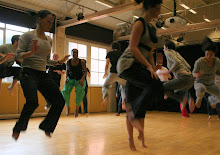
The first phase, research developed the initial idea of Porto. At the very beginning, we were asked to bring in an item which represented ourselves in some way. These items were then used to develop the basis of what is now Porto. As we had already built our pallet, we then started experimenting with ideas and characters. We were left to our own devices when it came to our characters and it was up to us to devise and develop back stories and personalities for them, through research as well as physical work. Oddey states that: “Devised theatre encourages and supports the notion of a group of people having the chance to be artists in their own right, to discover their own creativity in form and content.” (1996.) pg. 164.
This is the reason that I think our transition from the research to the score phase has gone so smoothly. We have all kept the ideas of journeys with us throughout, which came from a series of pictures and images which had themes which were inspired by the items we initially brought in. Due to the fact the devising process started with a personal connection to each of us, we have been able to focus more on the physical experimentation.
Gradually music started being added to each section, which at first many people didn’t notice as we are often so engrossed within the work. Although we are a large group, there is often a strong connection and themes running through our physical work, which is now being defined but the use of music and extra play sessions. We are now at the score phase where music is an important factor to the community of Porto, but I also feel that the research phase is still apparent, and that it will be right until the end.
There are some sections which have a stronger narrative/structure than others. The ensemble sections are particularly strong to me. As we work in unison, it is clear we are ‘one’. The two ‘odd’ figures – Nicola and Blake, have an impact on us as a community as they don’t fit in with the rest of us. Due to this, sub groups start to emerge and many of us split. Then I feel that some narratives may be seen differently to different people-mainly due to the nature of the work and the fact that each character is individual, but yet still an important member of the community.
“In devised experimental theatre where the body is the primary signification of the text, the gestural language (through the combination of narrative, text and physical movement) is the performance vocabulary for the work”) Oddey, (1996) pg.162.
The fact that the body is the most important tool within this genre means that it is the body that creates the narrative and movements, not the other way around. As Callery points out: “Physical theatre is theatre where the primary means of creation occurs through the body rather than the mind.” (2001) pg. 4
My characters transition has been immense, but mainly over the past two weeks. Although the morals, feelings and emotions have remained the same, they now include other people – rather than just for her. My character is still as determined as ever, but now that such strong connections have been made with other members of the community, the focus is also on them and I am more intrigued at how others can help me find out more about myself as well as experimenting with how both my character, and other characters respond and react to each other. During my research phase, I envisioned for my character to go on the journey alone. But now, within the scoring process I don’t think she could achieve anything without the other characters she’s connected with.
D, Callery. Through the body: a practical guide to physical theatre. Nick Hern Books, 2001.
A, Oddey. Devising Theatre: A Practical and Theoretical Handbook. Routledge, 1996.
Yesterday
Jasmin Vardimon Company
Tuesday, 31 March 2009

Assessment 3 - Daniel Smith
1.
The research inside of Porto stems from us, the performers. We began by creating our pallet and then began exploring how we felt within the community which has become Porto. Marshall comments on this by saying, “once you are connected to your body and able to listen to it, another realm of possibilities emerges.” (Marshall, 2001, p.31)
The ‘R’ phase of Porto is relevant to Marshall's quote because each individual performer has their own unique motives and understanding of their character. The ‘score’ phase has moved in gradually and material has become developed through the ‘play’ sessions. Because of this “the actor must be able to realize the demands of his imagination. He must have the physical acting skills necessary to create the character.” (Dennis, 1995, p. 19)
Since there are 38 performers in Porto, the research phase never stops until the end of the final performance. Scoring and research happen simultaneously because every rehearsal brings something new, this could either have been researched theoretically or performed physically. We are still scoring new material which we then have to apply our research to figure out if our character can achieve this without breaking their form.
2.
At present we are still scoring old material and creating new material. Through this it is clear to see that Porto has a well structured narrative. There are many reasons for this. Because we are still scoring there will be gaps in where sub groups material will be placed. The ensemble sections which lie within Porto have got clear narratives. For example at the beginning of Porto, the audience are introduced to new characters and are seen as a community. Inside this community there are two unknown figures that are unknown to the performers and audience. This section has a clear narrative that we are inside a world which has a nameless passer-by, a solitary figure lingering inside of a world.
There are some narratives which have not fully been developed and structure is absent from these. Because we are still scoring and validating the piece “the creating of theatre is a collaborative process, requiring the active responsibility of all those involved.” (Dennis, 1995, p. 71)
The process at which we are at now has the narrative in place which has began to shape quite adequately, some performers have created their own narratives within Porto’s large narrative, this will allow the audience to have a different understanding of each character as an individual and as part of a community.
3.
My characters transition from the research phase to the scoring phase of Porto has changed significantly.
Because our characters are an extension of ourselves I decided to create a new character with some existing traits. In devising work “the actor is to consider him as a storyteller whose specialty is that he is the story he is telling.” (Zarrilli, 1995, p. 22)
During the research phase I had a very clear idea of how my character was going to be played inside the community. However, once we started devising the work my characters profile stayed true to how I planned for this to be. After various rehearsals my character has changed drastically both physically and emotionally. There are a number of reasons why this has happened, my main reason for my characters change of persona is due to the other inhabitants within Porto. Originally my character started off in an unclear state of mind as to who he really was and what his purpose was, he also wanted to look for a friend inside Porto which had not happened as planned. Now my character has made a close bond with numerous people enabling my character to change behavior physically and emotionally.
Bibliography.
Dennis, A. (1995) The Articulate Body Nick Hern Books
Marshall, L. (2001) The Body Speaks Methuen Publishing Limited
Zarrilli, P. (1995) Acting (Re)Considered London: Routledge
The research inside of Porto stems from us, the performers. We began by creating our pallet and then began exploring how we felt within the community which has become Porto. Marshall comments on this by saying, “once you are connected to your body and able to listen to it, another realm of possibilities emerges.” (Marshall, 2001, p.31)
The ‘R’ phase of Porto is relevant to Marshall's quote because each individual performer has their own unique motives and understanding of their character. The ‘score’ phase has moved in gradually and material has become developed through the ‘play’ sessions. Because of this “the actor must be able to realize the demands of his imagination. He must have the physical acting skills necessary to create the character.” (Dennis, 1995, p. 19)
Since there are 38 performers in Porto, the research phase never stops until the end of the final performance. Scoring and research happen simultaneously because every rehearsal brings something new, this could either have been researched theoretically or performed physically. We are still scoring new material which we then have to apply our research to figure out if our character can achieve this without breaking their form.
2.
At present we are still scoring old material and creating new material. Through this it is clear to see that Porto has a well structured narrative. There are many reasons for this. Because we are still scoring there will be gaps in where sub groups material will be placed. The ensemble sections which lie within Porto have got clear narratives. For example at the beginning of Porto, the audience are introduced to new characters and are seen as a community. Inside this community there are two unknown figures that are unknown to the performers and audience. This section has a clear narrative that we are inside a world which has a nameless passer-by, a solitary figure lingering inside of a world.
There are some narratives which have not fully been developed and structure is absent from these. Because we are still scoring and validating the piece “the creating of theatre is a collaborative process, requiring the active responsibility of all those involved.” (Dennis, 1995, p. 71)
The process at which we are at now has the narrative in place which has began to shape quite adequately, some performers have created their own narratives within Porto’s large narrative, this will allow the audience to have a different understanding of each character as an individual and as part of a community.
3.
My characters transition from the research phase to the scoring phase of Porto has changed significantly.
Because our characters are an extension of ourselves I decided to create a new character with some existing traits. In devising work “the actor is to consider him as a storyteller whose specialty is that he is the story he is telling.” (Zarrilli, 1995, p. 22)
During the research phase I had a very clear idea of how my character was going to be played inside the community. However, once we started devising the work my characters profile stayed true to how I planned for this to be. After various rehearsals my character has changed drastically both physically and emotionally. There are a number of reasons why this has happened, my main reason for my characters change of persona is due to the other inhabitants within Porto. Originally my character started off in an unclear state of mind as to who he really was and what his purpose was, he also wanted to look for a friend inside Porto which had not happened as planned. Now my character has made a close bond with numerous people enabling my character to change behavior physically and emotionally.
Bibliography.
Dennis, A. (1995) The Articulate Body Nick Hern Books
Marshall, L. (2001) The Body Speaks Methuen Publishing Limited
Zarrilli, P. (1995) Acting (Re)Considered London: Routledge
Monday, 30 March 2009
Assessment 3 - Edward Critchlow
1) Upon devising a piece of theatre, one must go through different stages of the devising process. During the creation of ‘Porto’; we have worked through the ‘R’ and ‘S’ stages of the ‘RSVP’ model. The ‘R’ stands for the ‘research’ phase; this is where the concept for ‘Porto’ was shared with the ensemble. We were shown several images; which we learnt were representations of what ‘Porto’ means; the transition between spaces. Also in the ‘R’ stage, we were given tasks to work in a starting point for the individual development of characters. As Dymphna Callery states of choreographer Lloyd Newson, who founded ‘DV8’, he wanted ‘to create rather than simply interpret, Work was devised […] through shared research’ (Callery; 2001: p.g.7).
From there, we began the physical creativity of ‘Porto’, it is here where the ‘scoring’, the ‘S’ stage, of the piece begins. ‘Borrowing [from] the musical term to indicate that the principle of creation is one of composition rather than linear plot construction’ (Callery; 2001: p.g.165). This is where the material gathered in the ‘R’ stage begins to take shape and is created through improvisation, being choreographed/directed, group devising and creative play sessions as ‘play will inevitably inform the style of work you produce’ (Callery; 2001: p.g. 163).
Overall, the transition to the ‘scoring’ of ‘Porto’ ran smoothly.
2) As ‘Porto’ is starting to become scored, there will inevitably be some form of narrative that will run through out the performance. However, because the work created through out ‘Porto’ has been devised in a non linear manner it is difficult for the ensemble to notice any clear sign of narrative through the piece. I do believe that narratives between individual characters have become apparent. Due to the very start of the ‘scoring’ phase during creative play sessions and group devised work ‘each [character] explored what they felt was important for them’ (Hodge; 2000: p.g.215).
It is this exploration of what each character needs, does not need, feels or does not feel towards themselves and other characters within the ensemble, i.e. ‘the physical dialogue’ (Murray & Keefe; 2007: p.g.120) that creates individual and personal narratives for each character in ‘Porto’.
It could be, however, that it is these ‘physical dialogues’ (Murray & Keefe; 2007: p.g.120) between characters, is the narrative of ‘Porto’. That an audience member may identify with a character on stage and follow their journey through out the performance of ‘Porto’ and the journey of the character becomes the narrative for the audience member. Or at a simpler level, the narrative for ‘Porto’ is the journey and development of the characters.
3) My character development from the ‘R’ to the ‘S’ phase of devising ‘Porto’ has been a massive one. My character has completely changed. As mentioned in my previous blog entry, my initial character was me and was incredibly difficult to develop both the physicality and the emotional sate of the character. So my character became a stereotypical ‘bitch’. This came from returning to the ‘R’ phase and making ‘discoveries […] individually. Such work is particularly useful for developing characters’ (Callery; 2001: p.g.173) while also having the emotional impulse to work with another performer who I related to, allowed the ‘improvisation […] to focus on the interactive process’ (Callery; 2001: p.g.173), thereby allowing my character to develop.
From working with my new character during the ‘S’ phase, it has allowed my character to grow and one again change emotionally. From a stereotypical ‘bitch’, my character has grown into an ‘evil’ character’; one that many members of the ensemble fear to be around. As Pina Bausch states ‘we all want to be loved and liked. You think that there’s a point and if you go beyond that, then there’s no telling where it will lead’ (Huxley & Witts; 1996: p.g.58). Which is true of my character, but working through the ‘S’ phase of ‘Porto’ it has allowed me to ‘develop [my] ability of physical expression’ (Zarrilli; 1995: p.g.163).
Bibliography
Callery, D. (2001): Through the Body, London. Routledge
Hodge, A. (2000) Twentieth Century Actor Training, London. Routledge.
Huxley, M & Witts, N. (1996) The Twentieth Century Performance Reader, London. Routledge
Murray, S & Keefe, J. (2007) Physical Theatres: A Critical Introduction, Oxon. Routledge
Zarrilli, P. (2002) Acting (Re)Considered: A Theoretical and Practical Guide, 2nd ed. Oxon. Routledge
Posted By: Edward Critchlow
From there, we began the physical creativity of ‘Porto’, it is here where the ‘scoring’, the ‘S’ stage, of the piece begins. ‘Borrowing [from] the musical term to indicate that the principle of creation is one of composition rather than linear plot construction’ (Callery; 2001: p.g.165). This is where the material gathered in the ‘R’ stage begins to take shape and is created through improvisation, being choreographed/directed, group devising and creative play sessions as ‘play will inevitably inform the style of work you produce’ (Callery; 2001: p.g. 163).
Overall, the transition to the ‘scoring’ of ‘Porto’ ran smoothly.
2) As ‘Porto’ is starting to become scored, there will inevitably be some form of narrative that will run through out the performance. However, because the work created through out ‘Porto’ has been devised in a non linear manner it is difficult for the ensemble to notice any clear sign of narrative through the piece. I do believe that narratives between individual characters have become apparent. Due to the very start of the ‘scoring’ phase during creative play sessions and group devised work ‘each [character] explored what they felt was important for them’ (Hodge; 2000: p.g.215).
It is this exploration of what each character needs, does not need, feels or does not feel towards themselves and other characters within the ensemble, i.e. ‘the physical dialogue’ (Murray & Keefe; 2007: p.g.120) that creates individual and personal narratives for each character in ‘Porto’.
It could be, however, that it is these ‘physical dialogues’ (Murray & Keefe; 2007: p.g.120) between characters, is the narrative of ‘Porto’. That an audience member may identify with a character on stage and follow their journey through out the performance of ‘Porto’ and the journey of the character becomes the narrative for the audience member. Or at a simpler level, the narrative for ‘Porto’ is the journey and development of the characters.
3) My character development from the ‘R’ to the ‘S’ phase of devising ‘Porto’ has been a massive one. My character has completely changed. As mentioned in my previous blog entry, my initial character was me and was incredibly difficult to develop both the physicality and the emotional sate of the character. So my character became a stereotypical ‘bitch’. This came from returning to the ‘R’ phase and making ‘discoveries […] individually. Such work is particularly useful for developing characters’ (Callery; 2001: p.g.173) while also having the emotional impulse to work with another performer who I related to, allowed the ‘improvisation […] to focus on the interactive process’ (Callery; 2001: p.g.173), thereby allowing my character to develop.
From working with my new character during the ‘S’ phase, it has allowed my character to grow and one again change emotionally. From a stereotypical ‘bitch’, my character has grown into an ‘evil’ character’; one that many members of the ensemble fear to be around. As Pina Bausch states ‘we all want to be loved and liked. You think that there’s a point and if you go beyond that, then there’s no telling where it will lead’ (Huxley & Witts; 1996: p.g.58). Which is true of my character, but working through the ‘S’ phase of ‘Porto’ it has allowed me to ‘develop [my] ability of physical expression’ (Zarrilli; 1995: p.g.163).
Bibliography
Callery, D. (2001): Through the Body, London. Routledge
Hodge, A. (2000) Twentieth Century Actor Training, London. Routledge.
Huxley, M & Witts, N. (1996) The Twentieth Century Performance Reader, London. Routledge
Murray, S & Keefe, J. (2007) Physical Theatres: A Critical Introduction, Oxon. Routledge
Zarrilli, P. (2002) Acting (Re)Considered: A Theoretical and Practical Guide, 2nd ed. Oxon. Routledge
Posted By: Edward Critchlow
Task 3 - Lauren Walker
1) Within the devising process R represents the research/resource phase. The phase in which the process begins and the work starts off with a basic idea and then the actors take it on board and experiment with it. Once the experimenting has taken place and material has been produced we then move onto the score phase which is when the material is shaped and put into context within the piece. “Devising is a process of making theatre that enables a group of performers to be physically and practically creative and sharing and shaping of an original product…” (Oddey, 1994, p.1). Within Porto the transition from R to S has been quite smooth. As a group we have all grasped the idea of the piece and been able to play about with the movement we have created, from the beginning of the process where it was very minimal to now where were verging onto the S phase where it has completely come 360 and have produced some very meaningful material. Now were at the S phase, here is where we see whether the material fits all together and if there are problems and there have been, we rectify them by reverting back to the R phase and improve on the material we have already produced.
2) When given the word structure/narrative I immediately think of a story and it having a beginning, middle and an end. And when discussing Porto, I don’t see the stereotypical story. Of course there is a beginning, where we see each of our characters enter the stage some already being there but from then I see the piece as an observation of individual characters and how they interact with each other.
Within Porto our own individual characters and how they connect with one another in a way could be seen as a structure. The structure of diving into characters lives and experiencing what they are experiencing. “Readers want your characters to seem like real people. Whole and alive, believable and worth caring about. Readers want to get to know your characters as well as they know their own friends, their own family.” (Scott Card, 1988, p.4). Maybe the structure of the piece is not of the community as a whole but of the individual relationships and stories within it. “By the time they finish your story, readers want to know your character better than any human being ever knows any other human being.” (Scott Card, 1988, p.4).
3) My character has gone through a tremendous transition between the R and S phases. At the beginning of the research/resource phase my character was very inward and my movements were very limited because as my character I didn’t feel the need to express my self physically. But as the time has passed and my character has interacted with different and varied people my character has had a transformation. I feel now I am able to express myself physically and not be this shy, timid person. “What is movement? Are we concerned with electric impulses from the brain which trigger muscular responses and thus produce physical movement? Or do we anticipate the reply “Movement is life!?” (Hutchinson Guest, 1983, p.1). When it comes to my own character my movement is simply impulse driven, and only move when I feel necessary where as in the beginning of the process in some ways I forced myself to move. So not only has my character evolved but my knowledge of devising physical theatre has also.
Hutchinson Guest, A.( 1983) Your Move. A new approach to the study of movement and dance. The Netherlands: Gordon and Breach Publishers.
Oddey, A.(1994) Devising Theatre a practical and theoretical handbook. London: Routledge.
Scott Card, O.(1988) Characters & Viewpoint. United States of America: Writer’s Digest Books.
Scott Card, O.(1988) Characters & Viewpoint. United States of America: Writer’s Digest Books.
POSTED BY LAUREN WALKER.
2) When given the word structure/narrative I immediately think of a story and it having a beginning, middle and an end. And when discussing Porto, I don’t see the stereotypical story. Of course there is a beginning, where we see each of our characters enter the stage some already being there but from then I see the piece as an observation of individual characters and how they interact with each other.
Within Porto our own individual characters and how they connect with one another in a way could be seen as a structure. The structure of diving into characters lives and experiencing what they are experiencing. “Readers want your characters to seem like real people. Whole and alive, believable and worth caring about. Readers want to get to know your characters as well as they know their own friends, their own family.” (Scott Card, 1988, p.4). Maybe the structure of the piece is not of the community as a whole but of the individual relationships and stories within it. “By the time they finish your story, readers want to know your character better than any human being ever knows any other human being.” (Scott Card, 1988, p.4).
3) My character has gone through a tremendous transition between the R and S phases. At the beginning of the research/resource phase my character was very inward and my movements were very limited because as my character I didn’t feel the need to express my self physically. But as the time has passed and my character has interacted with different and varied people my character has had a transformation. I feel now I am able to express myself physically and not be this shy, timid person. “What is movement? Are we concerned with electric impulses from the brain which trigger muscular responses and thus produce physical movement? Or do we anticipate the reply “Movement is life!?” (Hutchinson Guest, 1983, p.1). When it comes to my own character my movement is simply impulse driven, and only move when I feel necessary where as in the beginning of the process in some ways I forced myself to move. So not only has my character evolved but my knowledge of devising physical theatre has also.
Hutchinson Guest, A.( 1983) Your Move. A new approach to the study of movement and dance. The Netherlands: Gordon and Breach Publishers.
Oddey, A.(1994) Devising Theatre a practical and theoretical handbook. London: Routledge.
Scott Card, O.(1988) Characters & Viewpoint. United States of America: Writer’s Digest Books.
Scott Card, O.(1988) Characters & Viewpoint. United States of America: Writer’s Digest Books.
POSTED BY LAUREN WALKER.
Sunday, 29 March 2009
Task 3 Gina Dobrovic
1. When devising theatre, often resource can be a material resource which ideas are built from. We were introduced to Porto through a series of images that we perceived as links and transitions, such as doors and stairways. As part of the research phase, these then lead us to discussing the theme of departures, arrivals, journeys and baggage. Also in research, we engaged in an imagery exercise of certain situations based around Porto’s idea, as a starting point for our characters.
From there, we began to embark on a creative journey, constantly researching and crafting. We have begun to move into the ‘score’ phase. When scoring, material is generated through things such as creative play and adding music and so on. In Porto, music is being carefully selected to mirror what we are creating in performance. For instance, choosing a song that repeats itself and is stuck in a pattern can reflect the people onstage who may be revealing this through the body.
Dymphna Callery says “…improvisation uses play to achieve an unforeseen result…Play is a much looser concept, like a jam session.” And describes how Peter Brook “not only uses play as a starting point [but also] as a basis for personal growth and self-development for his actors…” (Callery: 2001, pp.94-96) More and more we are participating in creative play sessions, where a lot of our material is being created or refined. New ideas appear every day from simply interacting through improvisation.
2. A narrative certainly begins to show itself occasionally in Porto but then I have the thought that this will never be a set piece with a narrative. It is always changing and will always change. I do begin to notice things have remarkably started to fit together, though. Considering we have created a lot of content through creative play, small narratives have most definitely been initiated. At the same time, we all seem part of something far bigger and more intriguing. As an ensemble, we have a lot of contact with Blake and Nicola, which in my mind is ‘the bigger picture.’ In the meantime, we are all making relationships with other people. When I first enter the space at the beginning of Porto I always imagine it to be a departure lounge at an airport. We are all travelling somewhere, part of this transition or journey. We become a form of community, of which some people just do not fit for a variety of reasons. However, I do strongly feel that Porto may never have a chronological reasoned narrative, because it is based on impulse. The narrative is whatever direction Porto may take.
Daria Halprin discusses how the body “reflects our way of being as humans” and that we are an array of “emotional responses, cognitive and imaginal thinking…motivated by a compilation of life experiences…destructive and creative imprints, impulses, and desires.” (Halprin: 2003, p.17)
3. My character has in many ways remained true to the original goals and themes set out in the original letter we sent. During the research phase, I wrote about my character’s departure as being “…one of fierce determination juxtaposed with a terrible fear.” The terrible fear seemed to consume my character to start with, instead of the determination as I had intended. The intent was on looking back at what she had left behind more than looking towards the future. This did surprise me, but I went with it.
However, the more we partake in the play, my character has accidentally become more confident, and is preoccupied with the present instead of the past. This is something that has happened naturally, yet was my original intention! It has most definitely not become more tangible! I do not think my character knows what she wants emotionally, and could change her mind at any point! Physically, she has yet to expand. To take more risks is my aim, and I feel until I initiate this, my character cannot reach her full potential. “We applaud the actor for ‘taking risks’, ‘exposing herself’…’” (Auslander, in Zarrilli 1993, p.60)
Bibliography
Callery, D (2001): Through the Body: London: Routledge.
Halprin, Daria (2003): Expressive Body in Life, Art and Therapy : Working with Movement, Metaphor and Meaning. London: Jessica Kingsley Publishers.
Zarrilli, P (1993): Acting (re)considered: Theories and Practices: London: Routledge.
Posted by Gina Dobrovic
From there, we began to embark on a creative journey, constantly researching and crafting. We have begun to move into the ‘score’ phase. When scoring, material is generated through things such as creative play and adding music and so on. In Porto, music is being carefully selected to mirror what we are creating in performance. For instance, choosing a song that repeats itself and is stuck in a pattern can reflect the people onstage who may be revealing this through the body.
Dymphna Callery says “…improvisation uses play to achieve an unforeseen result…Play is a much looser concept, like a jam session.” And describes how Peter Brook “not only uses play as a starting point [but also] as a basis for personal growth and self-development for his actors…” (Callery: 2001, pp.94-96) More and more we are participating in creative play sessions, where a lot of our material is being created or refined. New ideas appear every day from simply interacting through improvisation.
2. A narrative certainly begins to show itself occasionally in Porto but then I have the thought that this will never be a set piece with a narrative. It is always changing and will always change. I do begin to notice things have remarkably started to fit together, though. Considering we have created a lot of content through creative play, small narratives have most definitely been initiated. At the same time, we all seem part of something far bigger and more intriguing. As an ensemble, we have a lot of contact with Blake and Nicola, which in my mind is ‘the bigger picture.’ In the meantime, we are all making relationships with other people. When I first enter the space at the beginning of Porto I always imagine it to be a departure lounge at an airport. We are all travelling somewhere, part of this transition or journey. We become a form of community, of which some people just do not fit for a variety of reasons. However, I do strongly feel that Porto may never have a chronological reasoned narrative, because it is based on impulse. The narrative is whatever direction Porto may take.
Daria Halprin discusses how the body “reflects our way of being as humans” and that we are an array of “emotional responses, cognitive and imaginal thinking…motivated by a compilation of life experiences…destructive and creative imprints, impulses, and desires.” (Halprin: 2003, p.17)
3. My character has in many ways remained true to the original goals and themes set out in the original letter we sent. During the research phase, I wrote about my character’s departure as being “…one of fierce determination juxtaposed with a terrible fear.” The terrible fear seemed to consume my character to start with, instead of the determination as I had intended. The intent was on looking back at what she had left behind more than looking towards the future. This did surprise me, but I went with it.
However, the more we partake in the play, my character has accidentally become more confident, and is preoccupied with the present instead of the past. This is something that has happened naturally, yet was my original intention! It has most definitely not become more tangible! I do not think my character knows what she wants emotionally, and could change her mind at any point! Physically, she has yet to expand. To take more risks is my aim, and I feel until I initiate this, my character cannot reach her full potential. “We applaud the actor for ‘taking risks’, ‘exposing herself’…’” (Auslander, in Zarrilli 1993, p.60)
Bibliography
Callery, D (2001): Through the Body: London: Routledge.
Halprin, Daria (2003): Expressive Body in Life, Art and Therapy : Working with Movement, Metaphor and Meaning. London: Jessica Kingsley Publishers.
Zarrilli, P (1993): Acting (re)considered: Theories and Practices: London: Routledge.
Posted by Gina Dobrovic
Wednesday, 11 March 2009
Antionette blog 2
Improvisation has allowed the creators of the piece to revisit body memory, drawing on techniques that were taught and demonstrated previously. The interaction between other characters has become an exchange of growth and development allowing the performer to learn more about their character and perhaps to their surprise, things they didn’t know. This in return, this permits room for new material and ideas to be explored. It seems to be a key ingredient for creating Porto as it spurs the creator to do rather than think. The Improvisation Game by Chris Johnston supports this by stating,
Improvisation is a research tool, widely used by artists from all disciplines. It’s a staple procedure in creating performance. While more cerebral exercises such as writing or composing allow for greater control over decisions, improvisation can be deliver the shock material. With its spontaneous, unpredictable processes, improvisation can deliver the right- brain gifts that sneak in under the radar. (p5)
With any research, it is a constant trial and error until something works, fits or makes sense. Johnston goes on to explain that without doing so performance cannot truly exist, and the benefits of working in this way is that impulses are constantly thrown into the creation. This has had a positive affect on Porto in the sense that individuals are no longer responsible for their own responses to the space but others too. It has become a communal understanding that we work as one ensemble, yet, aiding the piece with individual and unique interpretations. Reinforcing the idea that a community of people stand as one but individually stands alone.
The process of my character hasn’t really changed in comparison to the beginning of Porto and to the community she exists in. This is a reflection of her not fitting into the space or her community. There have been occasions where there were opportunities for interaction with others and it has been on her terms whether she accepts or declines. In this sense there has been a journey for her as she would not interact at all initially. The body language has become more open, but interestingly not to her community see seeks acceptance else where. The idea of wanting to belong often confuses her as she see’s others who seem to have the same problem, attempting to comfort, she stops her self from doing so as she knows this space isn’t for her. It’s as if the process is developing inside her waiting to explode due to this secretive and confined behavior.
The process of my character within Porto has determined the confined body language she communicates. Which feels acceptable as Miranda Tufnell and Chris Mickmay explain that, “Our bodies are the reflections of our lives: sitting walking, standing, we absorb the impact of each day. Each thought and sensation makes changes in the body.”(Body, Space, Image. London.1990. p.1) This quote began to make me think if I had no speech what kind of story would my body tell and made me question life within Porto, what marks, prints and scars can my character offer to Porto. The character takes up as little space when feeling vulnerable or unsure for example when sitting in the chair tries to curl into the chair. The position of the characters body is always internally expressed, and therefore doesn’t have an open torso or an up right head. Fidgeting with the hands, neck, face and clothes communicates nervousness. In terms where the body falls within the space, all effort is given internally and to gravity as she stands slumped to one side applying pressure to one leg with the spine curled towards the floor. Analyzing the approach of my characters expression I feel it has achieved the concept of Tufnell and Crickmay’s idea which is to
[…] let the sensation of thought dissolve through the body. Let the movement inside of the body – of breath, of thoughts – move outside. Allow the sensations their own time and expression – yawning, rolling resting - waiting for a space between the thoughts, an unlocking of parts of the body – gap into which something new can emerge. (p1)
Bibliography
Johnston.C; The Improvisation Game. London, Nick Hern Book Ltd, 2006
Tufnell.M & Crickmay.C; Body, Space, Image.London, Dance Books Ltd, 1990
Improvisation is a research tool, widely used by artists from all disciplines. It’s a staple procedure in creating performance. While more cerebral exercises such as writing or composing allow for greater control over decisions, improvisation can be deliver the shock material. With its spontaneous, unpredictable processes, improvisation can deliver the right- brain gifts that sneak in under the radar. (p5)
With any research, it is a constant trial and error until something works, fits or makes sense. Johnston goes on to explain that without doing so performance cannot truly exist, and the benefits of working in this way is that impulses are constantly thrown into the creation. This has had a positive affect on Porto in the sense that individuals are no longer responsible for their own responses to the space but others too. It has become a communal understanding that we work as one ensemble, yet, aiding the piece with individual and unique interpretations. Reinforcing the idea that a community of people stand as one but individually stands alone.
The process of my character hasn’t really changed in comparison to the beginning of Porto and to the community she exists in. This is a reflection of her not fitting into the space or her community. There have been occasions where there were opportunities for interaction with others and it has been on her terms whether she accepts or declines. In this sense there has been a journey for her as she would not interact at all initially. The body language has become more open, but interestingly not to her community see seeks acceptance else where. The idea of wanting to belong often confuses her as she see’s others who seem to have the same problem, attempting to comfort, she stops her self from doing so as she knows this space isn’t for her. It’s as if the process is developing inside her waiting to explode due to this secretive and confined behavior.
The process of my character within Porto has determined the confined body language she communicates. Which feels acceptable as Miranda Tufnell and Chris Mickmay explain that, “Our bodies are the reflections of our lives: sitting walking, standing, we absorb the impact of each day. Each thought and sensation makes changes in the body.”(Body, Space, Image. London.1990. p.1) This quote began to make me think if I had no speech what kind of story would my body tell and made me question life within Porto, what marks, prints and scars can my character offer to Porto. The character takes up as little space when feeling vulnerable or unsure for example when sitting in the chair tries to curl into the chair. The position of the characters body is always internally expressed, and therefore doesn’t have an open torso or an up right head. Fidgeting with the hands, neck, face and clothes communicates nervousness. In terms where the body falls within the space, all effort is given internally and to gravity as she stands slumped to one side applying pressure to one leg with the spine curled towards the floor. Analyzing the approach of my characters expression I feel it has achieved the concept of Tufnell and Crickmay’s idea which is to
[…] let the sensation of thought dissolve through the body. Let the movement inside of the body – of breath, of thoughts – move outside. Allow the sensations their own time and expression – yawning, rolling resting - waiting for a space between the thoughts, an unlocking of parts of the body – gap into which something new can emerge. (p1)
Bibliography
Johnston.C; The Improvisation Game. London, Nick Hern Book Ltd, 2006
Tufnell.M & Crickmay.C; Body, Space, Image.London, Dance Books Ltd, 1990
Post Two Nicole Dixon
1. What are the key strategies of devising that have been used through the first 5 weeks of creating Porto? Reflect briefly on how these strategies have enabled the growth and development of both individual characters and the ensemble’s idiosyncrasies. (200 words)
The main focus and strategy used in the devising process of Porto has been the element of play and disregarding the traditional text-based dominance. Through the use of improvisation and experimentation it has allowed characters to grow and progress through the liminal zone that is Porto. Even when given a stimulus or idea in the form of a task; it is the responsibility of the performer to use this stimulus and develop it, in order for them to progress and to create a piece of performance. ‘Devising a performance is a process of collective creativity that liberates the potential of individuals and groups, allowing them to create their own performance narrative.’ (Dundjerovic, 2007, p26) During the first 5 weeks, working as a ensemble and individually have proven its difficulties, but it has also allowed the emergence of relationships, and through play; it has allowed these relationships to build and develop into stronger connections. It is with these relationships that the basis of Porto is built around. In the beginning of the piece we are all individuals, not quite knowing where we are, who we are with, or where we are going. Through the evolution of these new relationships it is allowing individual characters to progress through on their journey.
2. Analyse the growth of your own character from the beginning of Porto to where you are at in the process now. State the reasons for its development/change/refinement. (200 words)
‘Every day, people around the world pick up a novel or short story, eager to be whisked away to another realm.’ (Bodden, 2008, p5) I feel like my character is trapped in a book, and trying to reach the end to find out her own outcome and fate. Over the past 5 weeks my character has developed quite significantly in the fact that in the beginning she was completely lost, with no sense of direction or security. By the end of the first 5 weeks, my character is slowly but surely starting to become comfortable with herself, and those around her; and believes that in order to interact comfortably with others she needs to have a sense of control over herself. This is an immense step in the right direction for my character, and I feel we are only just seeing the beginning of her. The character herself has many hopes and aspirations but is struggling to overcome her personal barriers in order to reach them. At the moment my character is quite disorientated and in limbo and it is surprising to see that ‘ in this state of unknowing we are able to draw on reserves from deep inside ourselves and get beyond predictable responses.’ (Free and Ramsay, 2004 p97)
3. Identify your character’s physicality through detailed analysis of its body language. (For example describe your character’s use of spine and its relationship to gravity, its shift of weight in the pelvis and even the repetition of a key gesture) (200 words)
‘We experience ourselves through our bodies. Within ourselves we make sense of the external world and at the same time use our thoughts and imaginings to propel courses of action’ (Bloom and Shreeves, 1998 p7) I am beginning to understand that my character has many attributes that are not always thought provoked. She tends to slouch her shoulders forward and not align her spine. This is a subconscious trait that my character has developed throughout the 5 weeks. This may be because she feels she is carrying unnecessary weight on her shoulders, or because she feels she is not worthy of walking straight. Pisk (1990, p13) explains that ‘the spine transmits to the spectator messages such as being tense or relaxed […] and it assists to transform the shape of the body.’ It will be interesting to see over the coming weeks if my character develops more confidence and self worth, to see if this transforms her as a person and straightens her back. ‘In performance fear and self-consciousness can undermine the breath and hence our capacity for expression. By cultivating good breathing, we can combat this danger and regain purpose and confidence.’ Free and Ramsay, 2004, p 133) I have noticed when examining my characters breathing that her breathes are short and fast. This is something I will also be interested in, in the coming weeks.
Bibliography:
BLOOM, K and SHREEVES, R. 1998. Moves- A Sourcebook of Ideas for Body Awareness and Creative Movement Hardwood Academic Publishers
BODDEN, V. 2008. Creating a Character: Dialogue and Characterization. The Creative Company
DUNDJEROVIC, A. 2007. The Theatricality of Robert Lepage. Canada: McGill-Queen’s Press
FREE, J. and RAMSAY, N. 2004. Holistic Bodywork For Performers Wiltshire: The Crowood Press
PISK, L. 1990. The Actor and His Body London: Virgin Books
NICOLE DIXON
The main focus and strategy used in the devising process of Porto has been the element of play and disregarding the traditional text-based dominance. Through the use of improvisation and experimentation it has allowed characters to grow and progress through the liminal zone that is Porto. Even when given a stimulus or idea in the form of a task; it is the responsibility of the performer to use this stimulus and develop it, in order for them to progress and to create a piece of performance. ‘Devising a performance is a process of collective creativity that liberates the potential of individuals and groups, allowing them to create their own performance narrative.’ (Dundjerovic, 2007, p26) During the first 5 weeks, working as a ensemble and individually have proven its difficulties, but it has also allowed the emergence of relationships, and through play; it has allowed these relationships to build and develop into stronger connections. It is with these relationships that the basis of Porto is built around. In the beginning of the piece we are all individuals, not quite knowing where we are, who we are with, or where we are going. Through the evolution of these new relationships it is allowing individual characters to progress through on their journey.
2. Analyse the growth of your own character from the beginning of Porto to where you are at in the process now. State the reasons for its development/change/refinement. (200 words)
‘Every day, people around the world pick up a novel or short story, eager to be whisked away to another realm.’ (Bodden, 2008, p5) I feel like my character is trapped in a book, and trying to reach the end to find out her own outcome and fate. Over the past 5 weeks my character has developed quite significantly in the fact that in the beginning she was completely lost, with no sense of direction or security. By the end of the first 5 weeks, my character is slowly but surely starting to become comfortable with herself, and those around her; and believes that in order to interact comfortably with others she needs to have a sense of control over herself. This is an immense step in the right direction for my character, and I feel we are only just seeing the beginning of her. The character herself has many hopes and aspirations but is struggling to overcome her personal barriers in order to reach them. At the moment my character is quite disorientated and in limbo and it is surprising to see that ‘ in this state of unknowing we are able to draw on reserves from deep inside ourselves and get beyond predictable responses.’ (Free and Ramsay, 2004 p97)
3. Identify your character’s physicality through detailed analysis of its body language. (For example describe your character’s use of spine and its relationship to gravity, its shift of weight in the pelvis and even the repetition of a key gesture) (200 words)
‘We experience ourselves through our bodies. Within ourselves we make sense of the external world and at the same time use our thoughts and imaginings to propel courses of action’ (Bloom and Shreeves, 1998 p7) I am beginning to understand that my character has many attributes that are not always thought provoked. She tends to slouch her shoulders forward and not align her spine. This is a subconscious trait that my character has developed throughout the 5 weeks. This may be because she feels she is carrying unnecessary weight on her shoulders, or because she feels she is not worthy of walking straight. Pisk (1990, p13) explains that ‘the spine transmits to the spectator messages such as being tense or relaxed […] and it assists to transform the shape of the body.’ It will be interesting to see over the coming weeks if my character develops more confidence and self worth, to see if this transforms her as a person and straightens her back. ‘In performance fear and self-consciousness can undermine the breath and hence our capacity for expression. By cultivating good breathing, we can combat this danger and regain purpose and confidence.’ Free and Ramsay, 2004, p 133) I have noticed when examining my characters breathing that her breathes are short and fast. This is something I will also be interested in, in the coming weeks.
Bibliography:
BLOOM, K and SHREEVES, R. 1998. Moves- A Sourcebook of Ideas for Body Awareness and Creative Movement Hardwood Academic Publishers
BODDEN, V. 2008. Creating a Character: Dialogue and Characterization. The Creative Company
DUNDJEROVIC, A. 2007. The Theatricality of Robert Lepage. Canada: McGill-Queen’s Press
FREE, J. and RAMSAY, N. 2004. Holistic Bodywork For Performers Wiltshire: The Crowood Press
PISK, L. 1990. The Actor and His Body London: Virgin Books
NICOLE DIXON
Subscribe to:
Posts (Atom)